
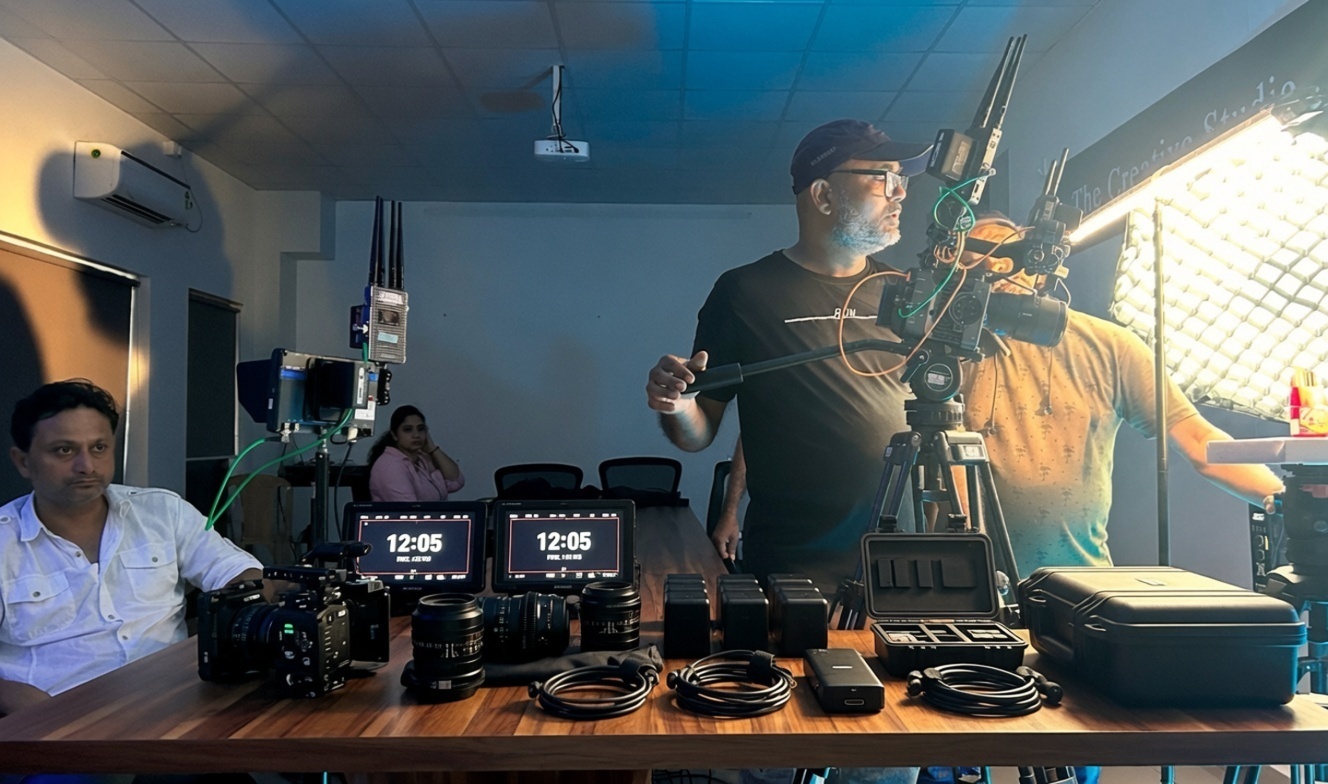
Over the years, working with brands across Mumbai, Bangalore, and Hyderabad, we’ve noticed one thing. Most brands do not struggle with budgets or ideas. They struggle with knowing which type of ad film will actually work for them at this stage of their growth.
We have made product films, brand stories, testimonial films, and documentary-style productions for businesses across industries. And the single biggest mistake we see brands make is choosing a format before understanding their goal.
This is our breakdown of the seven types of ad films that actually deliver results, what each one is built for, and the one decision that determines whether your film works or simply exists.
-
Product Demonstration Films
These films show the product doing exactly what it is designed to do. No metaphors, no storytelling detours — just the product performing under real conditions.
This format works best when the product itself is the proof. If what your product does is genuinely impressive, the smartest move is to step back and let the camera capture it honestly. Overproducing a demonstration film often weakens it. Audiences can tell when something is being dressed up to look better than it actually is.
Best suited for: Technology products, industrial equipment, and performance-driven consumer goods.
-
Brand Story Films
These films are less about the product and more about why the brand exists. They focus on the people behind it, the values that drive it, or the problem it was originally created to solve.
Brand story films are powerful when a company has built something meaningful and wants its audience to connect beyond the product itself. They are not the right choice when a brand is still figuring out its own identity. A story film without a clear point of view comes across as vague and forgettable.
Best suited for: Established brands, founder-led businesses, and companies with a strong origin story.
-
Testimonial Films
Real people. Real experiences. Minimal scripting.
Testimonial films work because they remove the brand from the conversation and let the customer speak. When done well, they are among the most credible formats in advertising. When done poorly, they feel rehearsed and staged — which makes them worse than having no testimonial at all.
The key is authenticity. A customer who speaks imperfectly but honestly will always outperform a polished spokesperson who sounds like they are reading from a script.
Best suited for: Service-based businesses, healthcare, education, and B2B brands.
-
Emotional Storytelling Films
These films lead with feeling rather than function. They build a narrative, introduce characters, and create a moment the audience connects with emotionally — often before the brand is even mentioned.
This is the format most people think of when they imagine a memorable ad. It is also the format most often executed poorly, because emotion cannot be manufactured. It has to come from a genuine human insight — about the audience, their lives, and where the brand fits into it.
Best suited for: Consumer brands, lifestyle products, and campaigns built around a cultural moment.
-
Corporate and Institutional Films
These films are built for a specific audience — investors, partners, employees, or stakeholders — rather than the general public. They communicate credibility, scale, and vision.
Corporate films are often underestimated. Brands treat them as an obligation rather than a strategy. But a well-made corporate film can shape how an entire industry perceives a company. The mistake most brands make here is prioritising information over impression. Facts matter, but how a company makes you feel in two minutes matters more.
Best suited for: Companies entering new markets, brands seeking investment, and organisations going through significant change.
-
Product Launch Films
Launch films have one job: create anticipation. They are built around a reveal — a moment, a reason for the audience to pay attention right now.
The best launch films treat the product like an event. They build tension before the product is fully visible, control the reveal carefully, and leave the audience wanting more. The worst launch films simply announce the product and list its features — which is the advertising equivalent of a press release.
Best suited for: New product releases, seasonal campaigns, and brand expansions.
-
Documentary Style Films
These films follow a real process, a real person, or a real environment to tell a brand’s story from the inside. They feel less like advertising and more like content worth watching.
Documentary-style films work because they earn trust. They do not ask the audience to believe the brand — they show something real and let viewers form their own opinion. This format requires confidence, because it means giving up some control over the narrative. But when it works, it creates a level of credibility that no scripted film can replicate.
Best suited for: Craft-driven brands, manufacturing companies, and brands with a compelling behind-the-scenes story. Particularly effective for industrial and heritage brands in cities like Mumbai and Hyderabad, where manufacturing and legacy businesses run deep.
The One Mistake Brands Make
Choosing the format before understanding the goal.
Most brands arrive at a production brief with a format already decided. They want something emotional, or something sleek, or they have seen a competitor’s film and want something similar. The format becomes the starting point instead of the outcome of a proper creative conversation.
The result is a film that looks like something but does not do anything. It exists, it gets approved, it goes live, and then it gets ignored.
The right question is never “what kind of film do we want to make?” It is “what do we need this film to actually do for our brand?” The format should follow that answer — not precede it.
How We Applied This on a Real Project
Understanding which approach fits the product is something we think about on every project. On one particular TVC, it shaped every decision we made — from how we structured the shoot to where we pointed the camera.
Our client needed a film for a range of speciality tyres built for extreme environments — mines, construction sites, and ports. The brief was clear on the outcome but open on the approach. We could have gone with a clean product demonstration. We could have scripted something aspirational. Instead, we proposed a combination of two formats — and here is how it played out.
The Challenge
From the outside, it sounded like a straightforward product film. It was not.
Shooting in active construction sites meant dealing with constant dust, dirt, and movement. The tyres, used naturally in these conditions, were not always camera-ready — yet they needed to look strong, reliable, and close to new in every frame. That meant continuous product preparation, managing unpredictable surroundings, and maintaining a controlled setup inside an environment that offered none of that naturally.
On top of that, the film had to meet high production standards — clean, premium, and international in its visual quality — all within an extremely tight timeline from concept to final cut in just a few days.
Our Approach
We did not begin with the shoot. We began with the product.
These tyres are engineered for demanding conditions, but simply showing them in use was not enough. We proposed capturing them at their source — the manufacturing facility — to show the precision and build quality behind their performance. We then paired that with on-ground footage showing what that performance actually looks like in the environments the product was made for.
The storytelling was kept visual and restrained. No over-explaining, no unnecessary narration. The product had enough presence on its own. It simply needed the right frame and the right sequence.
The Execution
The film was shot across two very different environments — the manufacturing facility and active on-ground locations.
At the facility, the focus was on detail. Controlled lighting and careful framing captured the finish and precision of the product up close. Out in the field, it was the opposite — real dust, real scale, real conditions. The team worked within active construction environments, constantly managing the surroundings to maintain visual consistency across every shot.
Before every setup, the product was cleaned, prepared, and reset. The team moved quickly without cutting corners. Production and editing ran in parallel to protect the timeline, and it held.
The Outcome
The film delivered on quality, on timeline, and on the brief.
The client was extremely satisfied with the result and appreciated how the execution matched their vision from the very beginning. Their response opened conversations about upcoming projects — and for us, that says more than any metric could.
What This Project Taught Us
Real environments are unpredictable. Tight timelines are unforgiving. But when the format decision is made for the right reasons — when the approach comes from understanding the product rather than copying a reference — everything else becomes easier to solve.
That is what we bring to every project. Not just a film that looks good on screen, but one that was made with a clear purpose behind every single frame.




Leave a Reply