
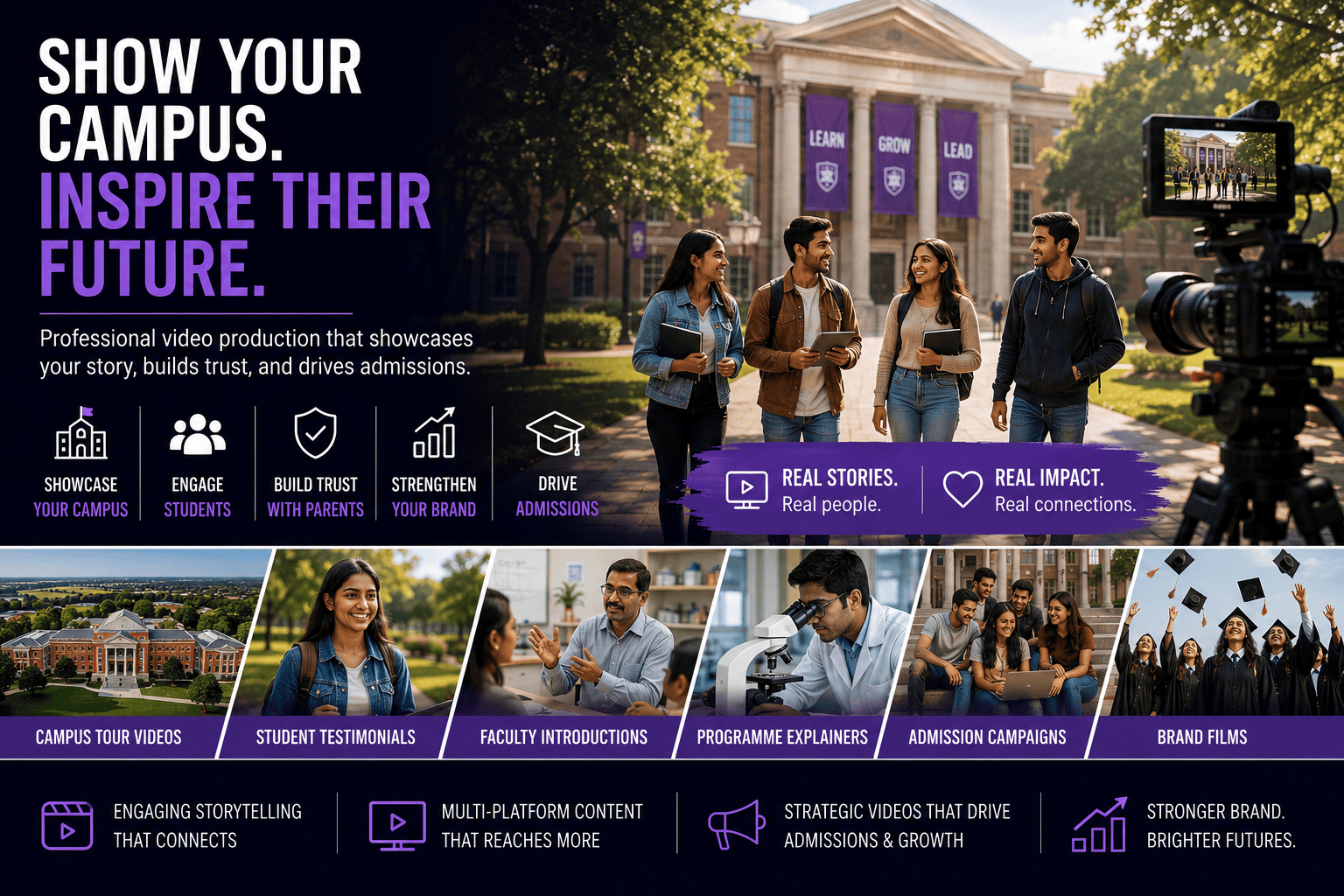
Schools, colleges, and universities are competing for attention in a crowded education market. Students compare institutions online, parents look for evidence of academic quality and safety, and prospective faculty members want to understand the culture before applying. In this environment, professional video production helps institutions communicate their identity more clearly than brochures, advertisements, or static website copy alone.
A well-planned video can show the campus, introduce faculty, highlight student experiences, explain programmes, and communicate the institution’s values. It can also be adapted for websites, social media, admission campaigns, open days, presentations, and internal communication.
Why Video Content Matters in Education
Student engagement
Students are accustomed to discovering information through video. A short campus clip, student interview, course explainer, or laboratory demonstration can help them understand an institution before they schedule a visit.
Video also makes complex information easier to absorb. Instead of reading several pages about a programme, a prospective student can watch a faculty member explain the curriculum, career pathways, facilities, and learning experience. For technical, medical, design, and vocational institutions, visual demonstrations can make the subject feel more practical and accessible.
The most effective education videos are created for a specific audience and purpose. Higher education video guidelines commonly recommend clear openings, authentic student or faculty voices, platform-appropriate formats, readable text, and captions for accessibility.
Parent trust
Parents often influence or share the decision about where a student studies. They want reassurance about teaching quality, campus facilities, student support, safety, placements, values, and the overall environment.
A professional video can answer these concerns through real visuals and credible voices. Parents can see classrooms, libraries, laboratories, accommodation, sports facilities, and student support areas. They can also hear directly from faculty members, current students, alumni, and leadership.
This does not mean presenting an unrealistic campus. Authenticity is more valuable than excessive polish. A video that shows genuine student experiences and explains what the institution actually offers is more likely to create confidence.
Brand credibility
An institution’s brand is shaped by every public interaction: its website, admission communication, social media, events, prospectus, and campus experience. Inconsistent or poorly produced videos can weaken that perception.
Professional educational video production brings consistency to visual language, sound, messaging, and brand identity. It allows an institution to present its mission, academic strengths, culture, and achievements in a structured way.
Video can also strengthen communication with alumni, donors, industry partners, accreditation bodies, and prospective faculty. A strong institutional film becomes a long-term brand asset rather than a one-time admission advertisement.
Types of Videos Educational Institutions Need
Campus Tour Videos
A campus tour video gives prospective students and parents a guided view of the institution. It can cover classrooms, laboratories, libraries, hostels, sports facilities, studios, cafeterias, transport areas, and student activity spaces.
A virtual tour is especially useful for students who live in another city or state and cannot visit immediately. It helps them understand the campus layout, atmosphere, facilities, and daily experience before making a shortlist.
The video should not simply display buildings. It should explain how students use those spaces and why the facilities matter to learning and campus life.
Student Testimonials
Student testimonials are among the most relatable forms of education content. Current students can discuss their course, faculty, friendships, projects, activities, challenges, and career preparation in language that prospective students understand.
The best testimonials are not fully scripted. A production team can prepare questions and key themes, but students should be allowed to speak naturally. Different students can represent different courses, backgrounds, interests, and stages of the student journey.
These videos can be used on programme pages, admission landing pages, social media, email campaigns, and counselling presentations.
Admission Campaign Videos
Admission campaign videos are designed around a specific intake, programme, or application period. They may explain eligibility, the application process, important dates, scholarships, campus facilities, or reasons to choose the institution.
Unlike a general brand film, an admission campaign video usually includes a clear next step, such as visiting the website, registering for an open day, downloading a prospectus, or submitting an application.
Short versions can be created for Instagram, YouTube, search campaigns, and other digital channels. Longer versions may be used during webinars, school visits, education fairs, and counselling sessions.
Faculty Introduction Videos
Faculty introduction videos allow prospective students to meet the people responsible for their learning. A professor can explain their subject, research interests, teaching approach, industry experience, and the opportunities available to students.
These videos are useful for institutions offering specialized or postgraduate programmes. They help students evaluate academic depth and understand the personality behind the course.
Faculty videos can also support recruitment by showcasing the institution’s intellectual environment to potential teachers, researchers, and visiting faculty.
Brand Films
A brand film presents the institution’s larger story. It may explore the founding vision, educational philosophy, student community, academic approach, social impact, alumni achievements, and future direction.
A strong brand film is not just a montage of smiling students and attractive buildings. It should answer a more important question: what makes this institution meaningful and distinctive?
This is where brand film production becomes valuable. A well-developed film can connect emotion with evidence, helping audiences understand both what the institution offers and why it exists.
Benefits of Professional Video Production
Better storytelling
Educational institutions have many stories to tell, but listing facts is not the same as communicating meaning. Professional storytelling helps organize information into a clear narrative.
For example, a university may want to communicate its focus on innovation. Instead of simply stating that it has advanced laboratories, the film can follow a student project from classroom discussion to prototype development, faculty guidance, testing, and final presentation.
This approach gives the audience a story they can understand and remember.
Higher reach
One professionally produced shoot can create a library of content. A campus film may become a website video, a two-minute overview, several student clips, short social edits, admission advertisements, and presentation content.
Videos can reach audiences through the institution’s website, YouTube channel, LinkedIn page, Instagram profile, email campaigns, online events, and paid media. Vertical and horizontal versions can be prepared for different platforms.
Captions, clear audio, and accessible graphics are important because many viewers watch without sound or may require text support. Institutional video guidelines also recommend planning content for multiple platforms rather than creating one format for every use.
Improved admissions marketing
Professional video can support different stages of the admission journey:
- Awareness videos introduce the institution to new audiences.
- Programme explainers help students understand their options.
- Campus tours answer practical questions.
- Student testimonials build familiarity and trust.
- Faculty videos demonstrate academic strength.
- Admission campaign videos encourage applications.
- Alumni stories reinforce career outcomes and long-term value.
The important point is to match each video to a clear purpose. A campus tour should not try to explain every course, and a brand film should not be overloaded with application instructions.
A video production company can help an institution plan these formats as a connected content system. When video is aligned with the admission funnel, it becomes more useful to marketing and counselling teams.
Strengthen Your Institutional Brand
Professional video production helps educational institutions communicate with greater clarity, consistency, and credibility. It shows prospective students and parents what the campus feels like, how faculty members teach, what students experience, and what the institution stands for.
The strongest results come when video is treated as a strategic communication asset rather than a one-time promotional project. A planned content library can support admissions, branding, recruitment, alumni engagement, fundraising, events, and internal communication throughout the year.
Purple Flicks helps schools, colleges, universities, and education brands develop purposeful films that combine strategy, storytelling, cinematography, interviews, motion graphics, and post-production. Explore our Corporate Video Production services, learn more about Brand Film Production, or connect with a Video Production Company to discuss your institution’s next video project.




Leave a Reply