
Walk into any supermarket and count the soaps, snacks, or detergents on a single shelf. They all promise more or less the same thing. Softer skin. Better taste. A cleaner home. So what actually tips a shopper toward one box over another?
Usually, it isn’t the product. It’s what the shopper already remembers about the brand before they even reached the shelf. And for most FMCG companies, that memory comes from advertising, especially video.
Here’s why professional ad films matter so much for this category.
Shoppers decide fast, so brands need to register instantly
Nobody spends a week comparing shampoos the way they’d compare cars or phones. These purchases happen fast, in the aisle or mid-scroll, often without much conscious thought at all. There’s no time for a brand to make its case at the point of sale.
That’s exactly why the impression has to be made earlier. A well-made ad film plants a simple idea in someone’s head long before they’re standing in front of the shelf, so when they finally see the product, it already feels like something they know.
Trust often comes from how the ad looks, not what it says
People think twice about what they put on their skin or feed their kids. A shaky, cheaply shot ad can quietly raise doubts about a product’s quality, even when the product itself is genuinely good.
A properly produced film has the opposite effect. Clean visuals and confident editing signal that a brand is established and takes itself seriously. In FMCG, that impression of credibility often carries more weight than any specific claim in the script.
Cutting corners on production tends to show
Plenty of FMCG companies, particularly smaller or newer ones, try to save money by shooting content in-house or on a shoestring budget. That can work fine for a casual social post. It’s a lot riskier when it’s the brand’s main advertising.
Shaky footage, muddy audio, or a script that sounds amateur can make even a solid product feel untrustworthy. And in a category built almost entirely on trust, that’s often enough to lose a customer before they’ve tried the product at all.
What this looks like at the top of the category
You don’t have to look far to see this principle in action. One of the largest names in personal and healthcare FMCG builds much of its brand equity through emotionally driven storytelling rather than product-feature ads everyday moments of care, with the product as a supporting detail rather than the headline, the kind of approach that only works when the film itself is well-crafted enough to carry the emotion. That brand also runs a deliberately integrated approach across TV, digital, and social, keeping the same tone everywhere a shopper might encounter it, so the impression compounds instead of resetting with every channel.
A leading international food brand takes a similar approach as it expands across markets — building content around a few core pillars, then localizing the visual identity and message rather than starting from a fresh brief in every region. It’s the same principle we build into every project: a strong ad film isn’t a one-off asset, it’s a template a brand can extend, market after market, without starting from zero each time.
Neither brand chases viral moments. Both play the long game — familiarity, trust, and recall, built one well-produced film at a time. That’s the game we play for our clients too.
Video still outperforms static ads, across every platform
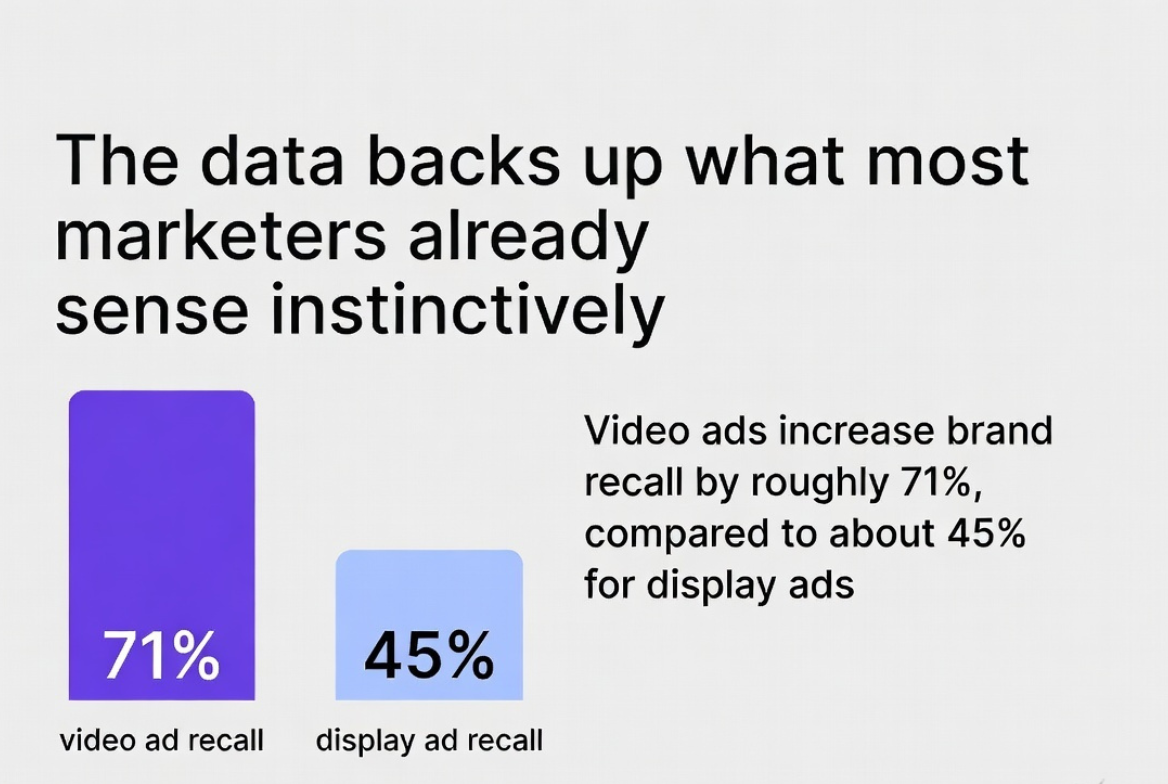
The data backs up what most marketers already sense instinctively. Video ads increase brand recall by roughly 71%, compared to about 45% for display ads. Emotionally engaging video creative drives around 27% higher recall than average-performing ads which lines up closely with the storytelling-led approach brands like J&J lean on. And pairing video with other channels compounds the effect further: combining TV and digital advertising lifts brand recall by about a third compared to TV alone.
TV, YouTube, Instagram, in-store screens it doesn’t matter much. Video consistently holds attention longer than a static image or a line of text. People are more likely to stop scrolling for it, and more likely to remember it afterward.For brands advertising across several platforms at once, this also makes video one of the more efficient places to put a budget. One solid film can usually be cut down into a handful of formats, for TV, social, and retail, instead of starting from scratch for each one.
The takeaway for FMCG brands
Whether you’re in personal care, food, beverages, or home care, a professionally produced ad film isn’t really optional at this point. It’s one of the more direct ways to build recognition, earn trust, and stay in a shopper’s mind in a category where they have endless options and very little time to weigh them.
At Purple Flicks, we work with FMCG brands to make ad films that are simple, memorable, and built for how people actually watch content today, whether that’s a six-second social cut or a full television commercial. If your brand’s ready to move past DIY content, let’s talk.




Leave a Reply