
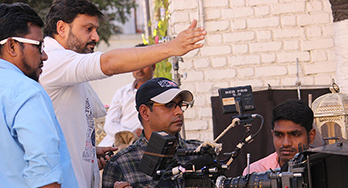
At Purple Flicks, every film has a dedicated film director from the first conversation to the final export. Not a project manager who hands your brief to a crew, but the person who will stand behind the camera and answer for the result. Here is how that works in practice, and why it makes a difference to brands, HR teams and CSR heads who work with us.
Why the director comes in on day one
At many production companies the director arrives after the script is signed off. At Purple Flicks, the director is on the first call. The reason is simple: the questions a director asks early (who must believe this film, what they should feel, what they should do next) shape everything that follows, from the script to the number of shoot days.
Our founder and director, Arvind Gupta, began his career in television at UTV, where he helped launch five channels, and went on to work with the Times Group and Sony SAB TV on promotional campaigns. That broadcast training, where a story has seconds to hold an audience, is still how our directors approach a corporate film or an ad.
Step 1: Listen before proposing anything
The first meeting is mostly questions. What does the business need this film to do? Who is watching, and where? What has been tried before, and why didn’t it work? Clients often arrive with a format in mind (“we need a 3-minute corporate video”), and the director’s job is to find out whether that format actually serves the goal. We have written more about this in what clients ask for versus what they really need.
Step 2: Turn the brief into a treatment
Next, the director writes a treatment: a short document that sets out the idea, the tone, the visual style, who appears on screen and how the story unfolds. It often includes reference frames and a rough structure. This is where the client sees the film before a rupee is spent on the shoot, and where most changes should happen, because changes on paper are cheap and changes on set are not.
Step 3: Plan the shoot around the story
Once the treatment and script are approved, the director leads the planning: location recces, permissions, casting or choosing employees to feature, the shot list and the schedule. Good planning also protects the client’s budget. One client, Mindfire Solutions, later wrote that Arvind planned their shoot across locations in a way that reduced both the time and the overall cost of the project.
Step 4: On set, the director guides people as much as cameras
On a shoot day the director works with the cinematographer on every frame, but much of the job is about people. Most corporate films feature employees and leaders, not actors. Helping a plant manager or a CEO speak naturally on camera takes patience and the right questions, not a teleprompter.
The same is true on industrial and project sites. When we filmed for BYO Towers in India, a wind tower with a 140-metre hub height was being installed with a new system for the first time. Our crew worked jointly with the project team on a process that was new to everyone on site. When we shot Indorama’s corporate film and HSE video in Nigeria, the team spent a week on site and, in the client’s words, guided them on what to include and what to leave out.
Step 5: The director stays through the edit
A film is written three times: on paper, on set and in the edit. Our directors stay in the edit suite with the editor, shaping the story, choosing performances and checking that the film does what the brief asked. Motion graphics, colour, sound design, music and voice-over are all reviewed against the original goal, not just for polish.
Clients see a first cut, give feedback, and the director turns that feedback into changes, explaining the trade-offs where a request would weaken the film.
Step 6: Deliver every version the client needs
The last step is making sure the film works everywhere it will be shown: the master film, short cuts for social media, vertical versions for Reels and LinkedIn, and subtitled or regional-language versions. Planning these in pre-production means they come out of the same shoot, at little extra cost.
Working with a director when you can’t be on set
Not every client can attend the shoot. Neuroclub’s Chief Scientific Officer worked with us from outside India and described the project as hassle-free, with guidance on everything from scripting to the final film. Clear treatments, shot lists and regular updates mean the director carries the client’s intent onto the set.
What this means for your next film
- One person is accountable for the creative result, from first call to final cut.
- Problems are solved on paper, before they become costly on set.
- Your people look and sound their best on camera.
- The finished film is built around your goal, not just a format.
Purple Flicks is a Mumbai-based video production house making corporate films, ad films, brand films, documentaries and vertical micro-dramas for brands including Suzlon, thyssenkrupp, Larsen & Toubro and Johnson & Johnson. Meet our team, see our work, or tell us about your project. You can also WhatsApp us on +91 99671 54869.
Arvind Gupta is the founder and director of Purple Flicks, a video production house based in Mumbai.


