
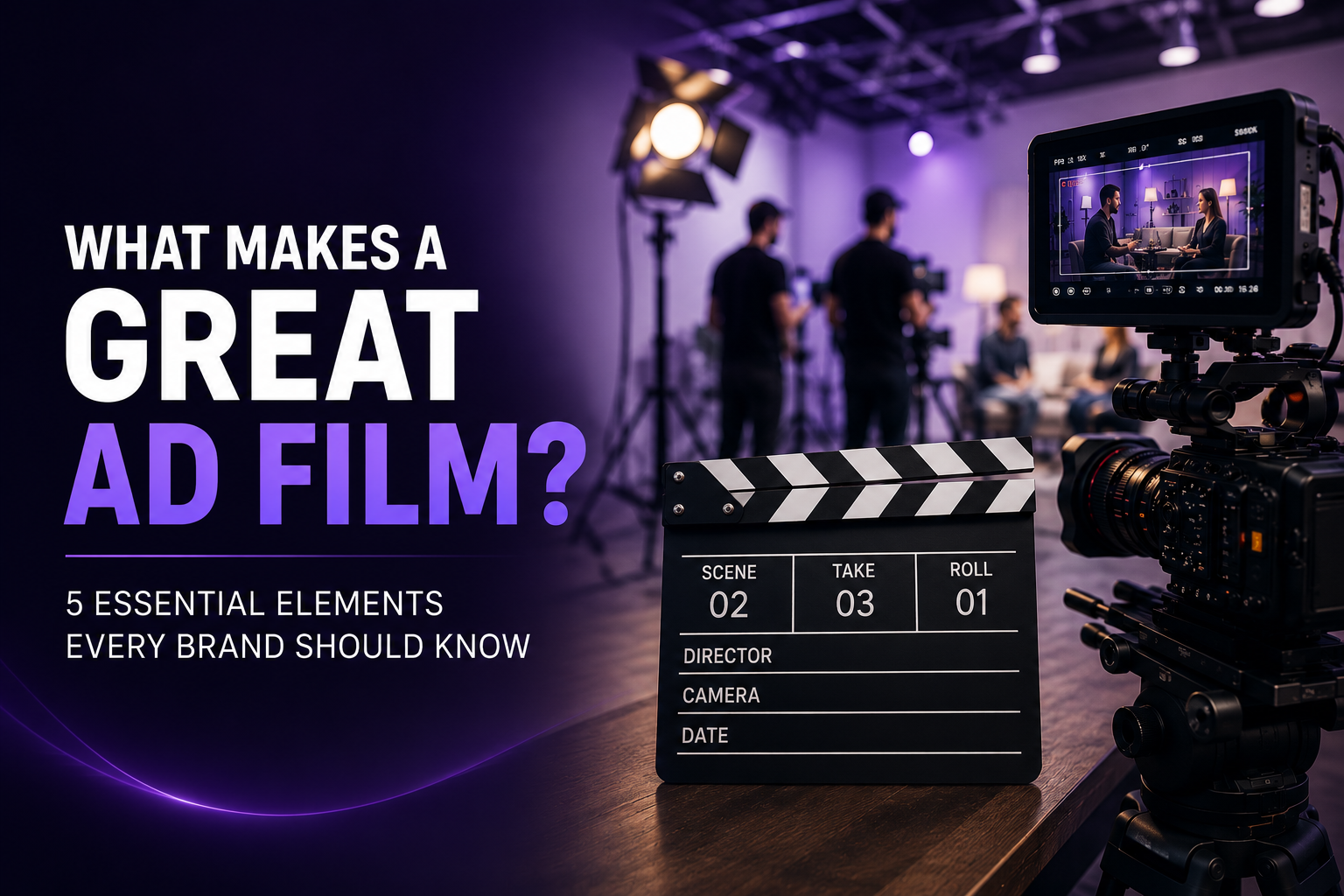
A great ad film blends sharp strategy, strong storytelling, and professional execution to create a campaign that people remember, share, and act on. When ad film production is treated as a strategic investment rather than just “getting a video made,” brands see real impact across awareness, engagement, and conversions.
Introduction
We’ve all watched ads that stick in our minds for years and others we forget the moment they end. The difference rarely comes down to budget alone; it’s usually about how well the idea, storytelling, and execution work together.
Memorable ad films are built on creative storytelling that expresses a brand’s promise in a way audiences can feel, not just understand intellectually. When brands and ad film makers align on this narrative, advertising films become powerful brand assets instead of disposable campaign content.
Understanding the Purpose of an Ad Film
Before thinking about shots, scripts, and locations, it’s essential to clarify what the ad film is meant to achieve.
Awareness
At the top of the funnel, ad films are designed to make people notice and remember the brand. Here, the goals include:
- Introducing the brand or a new product/service.
- Creating recall with a distinctive idea, visual style, or tagline.
- Positioning the brand clearly against competitors.
Awareness-focused ad film production prioritizes big ideas, memorable hooks, and strong branding elements over granular details.
Engagement
Once people know the brand, the next job is to deepen interest and connection. Engagement-driven ad films aim to:
- Hold attention beyond the first few seconds.
- Spark conversations, shares, or comments.
- Make viewers feel something — curiosity, empathy, aspiration, humour.
This is where storytelling, pacing, and character-driven narratives become critical. The best ad film agency or video production house understands how to structure scenes to keep viewers emotionally invested.
Conversion
Finally, some ad films are built to drive direct action — sign-ups, inquiries, purchases, app downloads, or store visits. Conversion-oriented ad films focus on:
- Communicating a clear offer, benefit, or solution.
- Removing doubts or friction with simple, reassuring messaging.
- Ending with a strong, specific call-to-action.
Here, creative storytelling and performance marketing need to work together: the film inspires, and the campaign mechanics capture the demand.
5 Elements of a Successful Ad Film
Strong Concept
Every great ad film starts with a strong central concept — a simple, powerful idea that ties everything together. A strong concept:
- Expresses the brand’s core promise in one thought (e.g., convenience, trust, joy, ambition).
- Is easy to explain in a single line, yet rich enough to build a narrative around.
- Guides all creative decisions: casting, locations, visuals, music, and script.
Without a clear concept, ad film services end up producing generic content that looks good but doesn’t say anything meaningful about the brand.
Emotional Storytelling
People don’t remember product features; they remember how a brand made them feel. Emotional storytelling is what turns a 30–60 second commercial into a mini experience. Effective emotional storytelling:
- Uses relatable characters and situations that mirror the audience’s life.
- Builds tension and resolution — a problem, a shift, and a satisfying outcome.
- Aligns the emotional arc with the brand’s role (helper, hero, partner, guide).
The best ad film agency knows how to balance emotion with clarity, so the brand is woven into the story rather than slapped on at the end.
High Production Quality
Viewers might forgive simple visuals in user-generated content, but expectations from brand campaigns are much higher. High production quality signals professionalism and trust. It typically includes:
- Strong direction: clear blocking, performance coaching, and visual continuity.
- Skilled cinematography: composition, lighting, camera movement that enhances the story.
- Clean sound and music: crisp dialogue, thoughtfully chosen score, and balanced mix.
- Polished post-production: editing rhythm, colour grading, titles, and graphics that feel on-brand.
Professional ad film makers and video production companies bring the right crew, equipment, and processes to ensure the film looks and feels premium, even when working within budget constraints.
Clear Brand Message
Even the most beautiful film fails if viewers don’t understand what the brand stands for or what it’s offering. A clear brand message means:
- The brand’s role is evident in the story — not forced, but unmistakable.
- The key benefit or positioning is easy to recall (e.g., fastest, safest, most trusted, most convenient).
- The tone of voice and visuals match the brand’s identity and segment.
This is where collaboration between marketing teams and ad film agency partners matters. The strategy and script must be aligned before cameras roll.
Effective Call-to-Action
In modern campaigns, especially digital-first ones, an ad film is rarely just “for branding.” It usually sits within a funnel with defined actions. An effective call-to-action:
- Tells viewers exactly what to do next (sign up, visit website, download app, book a demo).
- Is placed logically in the narrative — often at the end, but sometimes also hinted earlier.
- Is supported by campaign infrastructure: landing pages, tracking, retargeting, and follow-ups.
Ad film production that ignores the call-to-action often leaves potential results on the table. Even a brand-heavy film can include a subtle but clear next step.
Common Mistakes Brands Make in Advertising Films
Overloading Information
One of the most frequent mistakes is trying to say everything in one film: features, offers, brand history, testimonials, and corporate messages. This leads to:
- Crowded scripts with no breathing space.
- Confused viewers who don’t know what to focus on.
- Weak recall because nothing stands out.
A stronger approach is to choose one core message per film and let other details live in supporting assets like product walkthroughs, FAQs, or corporate video production.
Weak Storytelling
Sometimes brands focus so much on showing the product that they forget the narrative. Weak storytelling looks like:
- A sequence of shots with no emotional or logical progression.
- Characters who feel generic and unrelatable.
- Situations that don’t reflect real audience challenges or desires.
When storytelling is weak, even good production quality cannot save the film. Viewers may appreciate the visuals but won’t connect or remember the brand.
Lack of Strategy
Another common issue is treating an ad film as an isolated deliverable rather than part of a larger campaign strategy. Lack of strategy shows up as:
- No clear target audience definition.
- No alignment with brand positioning, upcoming launches, or performance goals.
- No distribution plan beyond “post it on social media.”
Successful brands work with ad film makers and agencies to define where the film will live, who it needs to speak to, and how success will be measured (views, engagement, leads, sales).
Why Work with Professional Ad Film Makers?
Creative Expertise
Professional ad film makers bring specialized creative skills that most in-house teams don’t have the bandwidth or experience to replicate. This includes:
- Turning a vague brief into a sharp concept and script.
- Balancing brand requirements with audience expectations.
- Designing visually and emotionally compelling scenes that support the message.
This creative expertise is especially important when the goal is to stand out in cluttered categories like FMCG, finance, real estate, or e-commerce.
Technical Quality
Technical execution can make or break how an ad film is perceived. Professional teams offer:
- Access to the right equipment (cameras, lenses, lights, sound gear, drones).
- Experienced crew — directors, DOPs, editors, sound designers, art directors.
- Smooth production management: scheduling, permissions, logistics, and contingency planning.
When brands partner with a capable video production house or video production company, they reduce the risk of costly errors and reshoots, while ensuring the final film looks polished across all platforms.
Campaign Effectiveness
Ultimately, ad films are marketing investments. Professional partners help ensure that each film contributes to campaign effectiveness by:
- Aligning creative with campaign goals (awareness, engagement, conversion).
- Delivering multiple edits and formats tailored to TV, digital, social, and in-store.
- Collaborating with media and performance teams to test and optimize variations.
The best ad film agency will not only produce the film but also advise on how it should be deployed to maximize ROI – which versions for top-of-funnel, which for remarketing, and which for specific audience segments.
Great ad films don’t happen by accident. They are the result of clear strategy, strong concepts, emotional storytelling, high production standards, and precise execution within a campaign framework. When brands see ad film production as a long-term brand asset rather than a one-off content requirement, every film becomes a building block in their larger narrative.
Working with professional ad film makers, agencies, and production houses gives brands the creative and technical foundation they need to stand out in crowded markets. In a world where audiences are bombarded with content, a well-crafted advertising film can be the difference between being just another ad in the feed and becoming the campaign people remember, talk about, and act on.




Leave a Reply